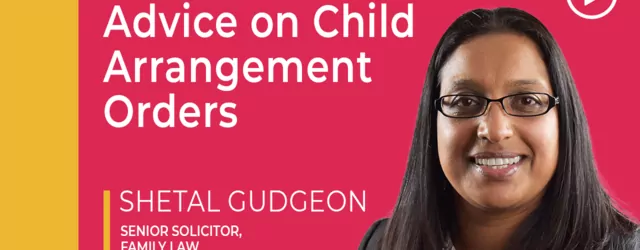


At Banner Jones, we provide professional advice to help you manage family law issues, including separation, divorce, and arrangements involving children. Appointments available Monday-Thursday from 7.30am and on Fridays from 8am.
Talk to Banner Jones. We are ready to help you.
You know your children better than anyone else, and as a parent, you are best placed to make important decisions about their care and wellbeing. But there may be times you need additional guidance and support regarding divorce with children.
If you’re getting divorced, separating, or your cohabiting relationship is ending, our divorce solicitors can advise you on a wide range of issues relating to your children. As far as possible, we can help you reach an amicable agreement in your children’s best interests. Where this is not achievable, we can apply to the courts for appropriate orders on your behalf.
Our divorce and family law solicitors in Chesterfield, Sheffield, Dronfield and Mansfield are here to support and guide you every step of the way.
We know that when relationships break down, it can put a lot of pressure on you and your family. Our expert family law solicitors are highly experienced and ensure every individual receives the utmost care and consideration throughout their case.
Remember: Advice from friends and family is often well-meaning, but it may relate to very different situations and can unintentionally create false expectations. Always seek professional guidance from a family law specialist, like Banner Jones.
Child Arrangement Orders (CAO) replaced the previous "Residence" and "Contact" Orders on 22nd April 2014. This change encourages parents to focus on the practical arrangements for their children instead of legal labels.
If you are seeking advice from our family law solicitors in Sheffield, Chesterfield, Dronfield or Mansfield, we can help you resolve the two main issues parents encounter: where a child will live and how much time they will spend with the parent they do not live with.
If you and your partner cannot agree on where your child should live, the court will make a decision based on the child’s welfare needs and best interests. While courts rarely separate siblings, they will do so if it clearly benefits the children.
Courts are now frequently granting “joint” or “shared care” orders. These include a “residence” element, which means the child effectively has two homes. The court can specify exactly when a child lives with each parent (such as during school terms or holidays) or provide a general outline if they believe both parents can agree on the details themselves.
A Child Arrangement Order (CAO) with a residence element legally prevents anyone from:
This part of the order settles when a child spends time with the parent they do not live with. These arrangements were previously known as “contact” or “access”. You do not need a court order to spend time with your child if both parents agree on the arrangements.
However, if the parent the child lives with makes it difficult for you to see your child, and mediation has either failed or is not suitable, you can apply for an order to secure this time. Navigating a divorce with children can be challenging, and our family law team is here to help you establish a routine that works for everyone.
Staying in touch can happen in many ways, including:
If the court has concerns about the level of care a parent can provide, it may order supervised or supported time. Supervised contact means another adult is present throughout the visit to ensure the child remains safe.
As your and the child(ren’s) circumstances change, original arrangements may no longer be suitable. Children might decide they no longer wish to visit the other parent, typically because they want to spend time with friends, or because the introduction of new partners and step-siblings has changed how they feel.
If your child(ren) struggle to follow an existing order, we recommend investigating the reasons and communicating with the other parent where possible. Dealing with changes quickly is better than letting the situation escalate, as ignoring a court order can lead to legal penalties.
We suggest talking to the other parent first to make any necessary adjustments, as this is the most effective way to change arrangements. If communication is difficult, our specialist family law solicitors can support and advise you through this process. If you still cannot reach an agreement, you may need to apply to the court to vary the existing order. We can help you clarify why this change is necessary and assist you with the making of a court application.
If you are concerned that a parent may take your child abroad without your consent, you must act quickly. We provide urgent legal advice to help prevent unlawful removal from England and Wales or to assist in a child's safe return.
A child’s wellbeing should always come before conflict between parents or carers. If one parent / carer is negatively influencing a child’s relationship with another, we can advise you on what legal steps can be taken.
Grandparents often play a vital role in their grandchildren’s upbringing, yet they do not hold automatic legal rights to see them. We can help you apply for court permission to secure a formal arrangement to maintain your relationship.
We have significant experience in all aspects of family law. Whether you are managing a divorce or child arrangement orders, our family law specialists handle every matter with the utmost sensitivity and care.
Every family is unique, and navigating the legal system can be complex. We make the process straightforward and hassle-free, providing the dedicated support you need to reach a positive resolution for your family.
Clear communication is vital during legal proceedings. Our family law team provides excellent service and compassionate support, which is why 97% of our clients say they would recommend us to a friend or relative.
We are recognised as a “Leading Firm” by the UK Legal 500 for seven consecutive years. Our expert solicitors help families across South Yorkshire, Derbyshire, and Nottinghamshire navigate their legal journeys with confidence.
We offer fixed-fee packages where possible to ensure there are no hidden costs. Our family law solicitors explain everything clearly from the start, so you have complete financial peace of mind while we help your family.


Download our free guide for help and advice on how to tell your children that you are separating.
Women's refugeIn the 2021 guide Shetal received this testimonial from a women's refuge;
‘Shetal Gudgeon has a long history of working with women fleeing domestic abuse. We recommend her to our residents because we like the manner and tone of voice she uses when communicating with our women. She makes them feel valued and important. She shows empathy and respect. This is something some of our women have never experienced. Our women need a certain kind of person as they have fled domestic abuse, lost their homes and sometimes children. They have complex needs and are dealing with trauma.’
Previously recognised as a recommended Family Lawyer in The Good Lawyer Guide – the independent guide to solicitors in England and Wales –She is well known for providing clear and practical advice described as “second to none” and leaving “no stone unturned”. She has also been described as “professional”, “welcoming” and “empathetic”. Shetal works closely with her contacts such as charities in the areas of domestic violence and sexual abuse.

Talk to Banner Jones. We are ready to help you.
You can get divorced in England or Wales if all of the following are true:
The aim when sharing out matrimonial assets is to be fair. Both spouses have to make full disclosure about their assets and debts before any decisions can be made about distribution, trying to hide anything won't work. Factors which are important when sharing out the assets include the current and future needs of each spouse and any dependent children; the length of marriage and the age, earning capacity and contributions of each party. Our family law Chesterfield team can guide you through this process.
In many cases, the answer is no. Under the no-fault divorce system in England and Wales, the legal process of ending a marriage is largely administrative and is usually dealt with online and through the court system without the need for either party to attend a court hearing.
However, while the divorce itself may not require a court appearance, disputes relating to finances, property or arrangements for children can sometimes result in court proceedings if an agreement cannot be reached. In many cases, these issues can be resolved through negotiation, solicitor-led discussions, mediation or other forms of dispute resolution, avoiding the need for a final court hearing.
These are separate legal issues and are not automatically covered by the divorce itself. You must reach a separate agreement regarding child arrangements and the division of assets. If you cannot agree, mediation is often required before seeking a court decision. Our family law solicitors in Sheffield, Chesterfield, Dronfield and Mansfield can explain the best options for your circumstances.
The judge prioritises the best interests of the child above all else. The court considers several factors, including the child’s own wishes and feelings (age dependant) and the ability of each parent to provide a stable, supportive environment. We help you present a clear case that focuses on your child’s wellbeing.
Yes, this is a common arrangement. If parents agree to share care, the court will almost always approve the plan. If you can’t reach an agreement, the court will step in to determine a schedule that serves the child’s best interests. Our family solicitors in Sheffield, Chesterfield, Dronfield or Mansfield can help you draft these agreements.
The law encourages both parents to play an active role in their children's lives. If problems arise, mediation is an excellent way to resolve disputes and maintain a healthy relationship. Our family law solicitors provide expert advice on Shared Care Agreements and "Live With/Spend Time With" orders to protect your parental bond.
Parental Responsibility covers the legal rights and duties regarding a child's welfare and education. While parents can make day-to-day decisions independently, major choices – such as schooling, medical issues or travelling abroad – require mutual consent. If a child is taken out of England and Wales without permission, we can assist with emergency court applications for their safe return.


Discover practical guidance for resolving disagreements over school choice and understanding how parental responsibility, mediation, and court applications work when separated parents cannot agree. Here, Shetal Gudgeon, our specialist Family Law Solicitor in South Yorkshire, Derbyshire, Nottinghamshire and surrounding areas explains your legal options and when obtaining legal advice can make a real difference.

Making a Will is commonly associated as something you do in later life however, in reality anyone over the age of 18 can have a Will and we would strongly recommend it to anyone with children.

When a Court issues an Order, it is legally binding and must be followed by all parties involved. Unfortunately, there are instances where one party may disregard or breach a Court Order, causing frustration and potential harm to the child and the other party. This article aims to shed light on the consequences and legal recourse available when a party breaches a Court Order in the context of family law.


Shetal Gudgeoun talks about the signs and symptoms of parental alienation and what you can do.

Download our free guide for help and advice on how to tell your children that you are separating.

You may well have heard in the news that the government are reforming the divorce process to introduce the so called ‘no fault divorce’ . This shall remove the element of fault and blame from the current divorce process and it is hoped that this will assist separating couples, making the court process less fraught and upsetting.

Grandparents in England and Wales do not have an automatic legal right to see their grandchildren. But that is not the end of the story. Get expert advice to help you manage family matters, including divorce and arrangements involving children. Talk to our family law and divorce solicitors in Sheffield, Chesterfield and Mansfield today.

All child vaccinations in the UK are voluntary and therefore parental consent must be given prior to the vaccination.

This guide explains the divorce process and covers the key points that anyone considering, or in the process of, a divorce should understand.


During a break up, being fair and civilised to each other is often the best you can hope for, but when there are children involved emotions need to be set aside.

Planning ahead is important for most family holidays, but if you are looking to take your children abroad and you have separated or divorced, then the sooner you prepare this, the better.

What’s the worst that could happen if you don’t have a Will? Our expert Wills solicitors have explain what can happen, in simple terms, in our guide.

We've created a downloadable resource to help you to understand the key factors and procedures in applying to court.

Getting through a divorce or separation is hard at the best of times but is often even harder when there are children involved in the relationship. Use our helpful guide for tips on explaining the situation to the children.

Mrs L, HaslandDivorce
You can't begin to imagine how grateful I am to you. You have been matter of fact rather than thinking about the earning potential. You are a lovely women so thank you so so much.
Mr W, SwintonI would like to say a big thank you for your understanding at a very stressful time. You not only acted professionally but with great compassion. My family can not say in words how difficult a time we are having, and it means so much to have just a little kindness. No matter what the outcome today, you did a wonderful job.
Mr G, StaveleyYou were very helpful and sympathetic whilst dealing with my case and your knowledge and advice was excellent. Once initiated, my case was dealt with speed, professionalism. Good contact and communication was maintained throughout.
Mrs B, BoythorpePeter Jones is a very good solicitor, and helped and advised me to do what was best. He does not pressure you into taking his advice.
Mrs D, GrassmoorAbsolutely brilliant service. Thank you so much!
Miss M, ChesterfieldBanner Jones Solicitors provided an excellent service in what was a slow and difficult divorce matter. The advice and persistence was very reassuring and eventually led to a good outcome.
Mrs W, MansfieldVery efficient, friendly and professional. We would definitely recommend to friends and family. They made the whole experience problem free.
Mr C, DronfieldVery easy to make appointments, very personal service from all people at Banner Jones, my solicitor was very friendly and put me at ease. If I needed a solicitor again, Banner Jones would be the first on my list.
Mr & Mrs D, MansfieldCannot fault the service, efficient, prompt and cautious. Matters explained very well and clearly. Pleasantly surprised.
Mr W, NottinghamshireService provided was excellent. All the staff were very helpful, considerate and professional. I would highly recommend to friends and family.